
Remodeling journal
How Much Do Upper Kitchen Cabinets Weigh?
How much do upper kitchen cabinets weigh? Size and material change the lift. See the 600-pound wall test and what to ask before you load them.
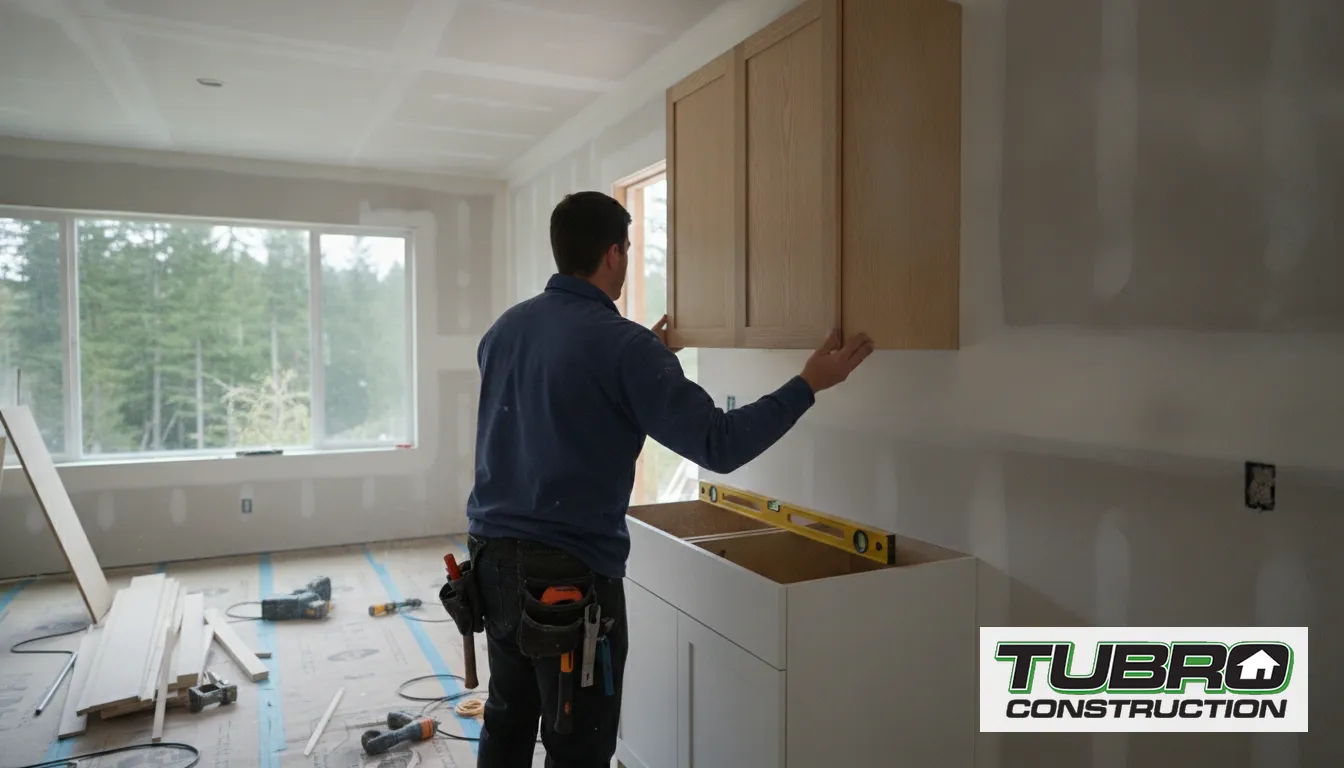
How much do upper kitchen cabinets weigh? An empty wall cabinet is a different question from how much that cabinet can hold once it is fastened to the wall. There is no single empty weight that fits every box. A short cabinet with one door is a lighter lift than a wide, tall cabinet with solid doors, a fixed shelf, and glass inserts. What you can store inside depends on the cabinet, the fasteners, and the wall behind it.
The useful published benchmark is a test, not a shopping average. The Kitchen Cabinet Manufacturers Association loads cabinets in its A161.1 program with 600 pounds while they are mounted. Shelves and bottoms in that same test are loaded at 15 pounds per square foot for seven days.
That test applies to cabinets in the program. It is not a rating for every upper cabinet already hanging in a Western Washington kitchen. If you are replacing cabinets, ask the manufacturer for the product you are buying, and ask the installer how that box will be fastened. Tubro Construction plans kitchen remodeling around the room you actually use, including the storage those uppers have to carry.
Call 253-216-2633 for a free estimate, or request an estimate online. The form asks for a proposal. It does not reserve an appointment.
How much do upper kitchen cabinets weigh when they are empty?
People search for an average for a practical reason. They want to know if two people can lift the box, or if a hallway delivery will be awkward. The honest answer is a range driven by the cabinet in front of you, not a universal number.
Width and height do most of the work. A 12-inch or 15-inch cabinet with one door is a small box. A 36-inch or 42-inch cabinet with two doors, a center stile, and one or two shelves is several times the material. Height matters the same way. Many uppers stop around 30 or 36 inches. A cabinet that runs closer to the ceiling is a different lift and a different fastening job. So is a stacked pair with a smaller cabinet above the main one.
Material and doors change the weight again. A framed box with solid wood doors is heavier than a lighter box with a flat or slab door of the same size. Glass inserts can add weight and they also change what you are willing to store behind them. An interior roll-out, a vertical tray divider, or a heavy pull-down shelf is part of the cabinet, not part of the dishes you add later.
None of those differences produces one published empty weight you can use for every brand. Stock, semi-custom, and custom lines do not share one box. If the crew needs a weight for a lift, a staging plan, or a tight stair, ask for that cabinet's specification. The supplier can also weigh a sample of the same size. Do not treat a forum average as the number for your order.
Depth is usually the smallest variable. Uppers are commonly about 12 inches deep, which is why they can look lighter than they feel. The weight is in the height, the doors, and the shelf, not in a deep carcass. A base cabinet feels different because it is deeper and it sits on the floor. This article stays with the wall cabinet.
Empty weight is not the same as what the cabinet can hold
Once the cabinet is on the wall, the question changes. You are no longer asking what the carpenters have to lift. You are asking what the mounted box, its shelf pins or clips, and the wall fasteners can carry day after day.
Those are three different loads:
- The empty cabinet is what gets carried up a stair and held against the wall while it is fastened.
- The shelf load is what one shelf can carry without sagging or pulling its supports out.
- The mounted load is what the whole cabinet can carry without stressing the screws, the hanging rail, or the studs.
Everyday dishes are usually the lightest of the things people worry about. A run of dinner plates, bowls, and glasses spread across a shelf is a normal kitchen. The loads that cause trouble are concentrated. Think of stoneware stacked on one short shelf, a small appliance parked in an upper, or bulk pantry goods in a cabinet planned only for cups. Cast iron and appliance storage belong lower, in drawers or base cabinets, unless the design specifically calls for them up high.
Use the questions below when you compare products. They keep the conversation on your cabinet instead of a number copied from another brand.
| Question | What actually changes the answer | What to ask |
|---|---|---|
| How heavy is this upper before it is installed? | Width, height, door style, and shelf count. Solid doors differ from glass. | Ask for this size's weight, or lift a sample, before delivery day. |
| How much can one shelf hold? | Shelf thickness and span. Metal supports differ from plastic. | Ask which supports come with the box. Ask if a wide shelf can get a center support. |
| How much can the cabinet hold once it is on the wall? | The cabinet rating, the fastener, and whether screws hit studs. | Ask for the mounted-load guidance. Ask how this wall will be fastened. |
| Can I put the heaviest items up high? | What you store. Paint color and door style do not decide this. | List plates, glassware, small appliances, and pantry overflow before the layout is locked. |
If you want a method for deciding what belongs in each opening, use the kitchen cabinet storage plan. That guide is about contents and daily tasks. This one is about the weight of the box and the load on the wall.
What the 600-pound wall-cabinet test actually means
The number that shows up most often in this search is 600 pounds. It comes from a certification test, and it is worth reading carefully.
The Kitchen Cabinet Manufacturers Association describes the tests behind its A161.1 Quality Certification Seal. In that program, shelves and bottoms are loaded at 15 pounds per square foot for seven days. Technicians watch for joint separation or a failure of the cabinet or its mounting. A separate test gradually loads 600 pounds into mounted cabinets to simulate a heavily loaded cabinet. Doors and drawers in the same program are cycled 25,000 times.
KCMA also describes a separate impact test. A 3-pound steel ball is dropped onto cabinet bottoms. That test is about durability, not about how many dishes you may store.
Read that as a laboratory test for cabinets submitted to the program. It is not a promise that every upper in a home can hold 600 pounds of dishes. A cabinet can fail far below a number you saw online. That includes a cabinet that was never certified, a cabinet fastened only into drywall, or a shelf held by light plastic clips.
The 15-pounds-per-square-foot shelf test is also easy to misread. It is a uniform load over the shelf area for a week in a lab. It is not a license to pile that much weight on the front edge of a thin shelf.
A 600-pound test load is spread through a mounted cabinet under lab conditions. It is not 600 pounds of dinnerware stacked on the top of the cabinet, and it is not 600 pounds hanging from one door. If a product is KCMA certified, you can ask to see that the line you are buying carries the seal. If it is not, ask the manufacturer what load the mounted cabinet and the shelves are built for. A missing answer is a reason to keep heavy storage down low.
Certification also does not replace the install. A tested cabinet still has to be fastened the way the manufacturer specifies. The test assumes a proper mount. It does not repair a missed stud.
The wall and the fasteners decide what you can store
An upper cabinet carries its own weight plus whatever you put in it. All of that load goes into the fasteners and the framing. The cabinet face is not what holds it up.
On a typical wood-framed wall, the screws or the hanging rail need to land in studs, not only in drywall. A wide cabinet usually has more than one stud behind it. A narrow cabinet sometimes has one, and sometimes the stud is not where the mounting holes want it to be. That is an install problem to solve with the layout, a rail, or blocking, not by hoping the drywall holds.
Older houses in King County and Pierce County do not all share the same wall. You may find plaster, a furred wall, a prior patch, or a cabinet run that was scribed around a wall that is not flat. None of those conditions has one statewide fix. The site visit is where someone checks what the screws will actually bite.
Tubro assigns a project manager to each project, so that question has a person attached to it. The team uses 20/20 design software to render the kitchen before work begins. A picture of the cabinet run is not a substitute for finding the studs. It does let you see which openings should hold the heavy everyday dishes before anything is ordered.
A few practical limits are worth stating. They are not a building code:
- Do not hang a wall cabinet from drywall anchors alone when the manufacturer calls for studs or a rated rail.
- Do not assume a new cabinet can reuse the screw holes from the old one. The new box may not line up, and the old holes may be loose.
- Do not load a cabinet that is only temporarily braced. The finished fastening is what the load depends on.
- Ask who supplies the screws or rail, and whether blocking will be added where a stud is missing.
The sequence of removal, leveling, and punch-list checks lives in our kitchen cabinet installation guide. Use that when you want the order of work. Use this page when the question is weight and holding power.
How to talk about weight before you order
Bring a short list of what actually goes in the uppers. That list is more useful than a guess at total pounds.
Separate everyday dishes from the heavy exceptions. Dinner plates for the household, everyday bowls, and drinking glasses are the normal upper-cabinet load when they are spread out. Note anything heavier. That might be a large stoneware set, stacked serving pieces, a stand mixer you hoped to hide, or cans and bulk goods. If several of those belong above the counter, move them. A base drawer or a tall pantry is a better place than an upper that was not fastened for that job.
Also separate the cabinet you are buying from the cabinet you are keeping. Refacing leaves the old boxes on the wall. Replacement puts new boxes up. Those are different weight conversations, and the choice between them is covered in cabinet refacing versus replacement. If the old uppers are staying, ask whether the existing fastening is still tight before you add more dishes.
Look at the mount if a door no longer closes, a shelf dips, or a cabinet moves when you load it. That is not a reason to add another shelf of plates.
Price is a different page. Width, door style, and whether the line is stock or custom all change both cost and, sometimes, the box itself. Read what goes into kitchen cabinet cost when you are comparing proposals. Do not use a price sheet as a load rating. A more expensive door does not tell you the shelf can hold more.
At the estimate, ask these questions in plain language:
- What does this upper weigh empty, for the sizes on our drawing?
- What load does the manufacturer publish for the mounted cabinet and for the shelves?
- Is this line in a certification program such as KCMA A161.1, and can we see that for the product being ordered?
- How will these cabinets be fastened on our walls, and what happens where a stud does not line up?
- Which items on our list should move to drawers or a pantry instead of an upper?
Tubro Construction is veteran-owned, founded in 2010 by Rich Tietjen, a U.S. Army veteran. We are a remodeling and general contracting company serving homeowners in King and Pierce Counties. Estimates are free, and the pricing we describe is upfront, with no hidden fees. The estimate is where those five questions get answered for your kitchen, not from a national average.
What Western Washington homeowners should plan around
Upper cabinets are interior work. The rain does not change what a shelf can hold. It does change how the boxes arrive and where they sit before they go on the wall.
Fall and winter are common times for a kitchen project because the room can stay in use while the weather outside is wet. A run of uppers still has to come through a door, and sometimes up a stair, while the rest of the house is occupied. Ask where the crates will be staged and how the floor will be protected. Also ask whether they should arrive on install day instead of a week early.
An empty cabinet can still scuff a floor or block a hallway if there is nowhere to set it down. That is true even when two people can lift it.
Local rules are not one rule. A cabinet replacement can raise different questions than a project that moves plumbing or opens a wall. That is true in Maple Valley, Kent, Auburn, Bellevue, Puyallup, and Tacoma. Weight and fastening are not, by themselves, a permit topic we can answer from another city's job. Ask who will check whether your scope needs a permit. Do not treat a neighbor's project as the rule for yours.
If the kitchen is also getting new counters, a backsplash, or a different layout, keep the cabinet load in the same conversation as the layout. A cabinet above a range, beside a window, or over a sink is chosen for clearance and for what you store there. The drawing should show those openings before the boxes are built. Our team at Tubro includes the estimator and the project manager who walk that drawing with you. Heavy storage gets a place on purpose.
Frequently asked questions
How much does an average upper kitchen cabinet weigh?
There is no single average that covers every brand and size. A narrow one-door cabinet is a much lighter lift than a wide, tall cabinet with solid doors and a glass insert. Ask the supplier for the weight of the sizes on your order. You can also lift a sample of the same box. Do not use a number from a different product.
How much weight can you put in an upper cabinet?
It depends on that cabinet and on how it is fastened. In the KCMA A161.1 program, mounted cabinets are tested with a 600-pound load. Shelves are tested at 15 pounds per square foot for seven days. Those figures describe the certification test. They are not a storage allowance for an uncertified cabinet or for a cabinet screwed only into drywall. Spread everyday dishes out, and keep cast iron, small appliances, and bulk pantry storage lower unless the design says otherwise.
Does a heavier cabinet mean it can hold more?
Not by itself. A heavier door or a thicker stile can mean a sturdier box, or it can just mean a heavier door. Holding power comes from the box, the shelf supports, and the fasteners in the studs. Ask for the manufacturer's shelf and mounted-load guidance instead of judging by how the door feels.
Can I store things on top of the upper cabinets?
Usually that is a poor place for anything heavy. The top of an upper is not the same as the shelf inside a tested cabinet. Items stored there are harder to reach and easier to overload on one side. If you need that space, ask before the cabinets are ordered whether the box and the mount are meant for it. Do not assume the 600-pound certification load applies to objects stacked on top.
Should cabinet weight change whether I reface or replace?
Weight alone should not make that decision. Refacing keeps the existing boxes and their current fastening. Replacement lets you change the box, the shelf, and how it is mounted. Compare the two paths, including cost, in the refacing and replacement guide, and have the existing screws checked if the old cabinets will stay.
Ask about the cabinet you are actually buying
How much do upper kitchen cabinets weigh, and how much can they hold, are both product-and-wall questions. Get the empty weight for your sizes from the supplier. Treat the KCMA figures as a certification benchmark, not as a guess for the cabinet already in your kitchen. Those figures are 600 pounds on a mounted test cabinet, and 15 pounds per square foot on shelves for seven days. Then match the heavy items on your list to drawers and pantry storage when an upper is the wrong place.
Call 253-216-2633 or request a free estimate. We will look at the uppers, the wall, and what you need to store before any cabinet is ordered.
Bring your ideas. We’ll talk through the next step.
Tell us about your home, your project city, and what you would like to change.
Request a Free Estimate